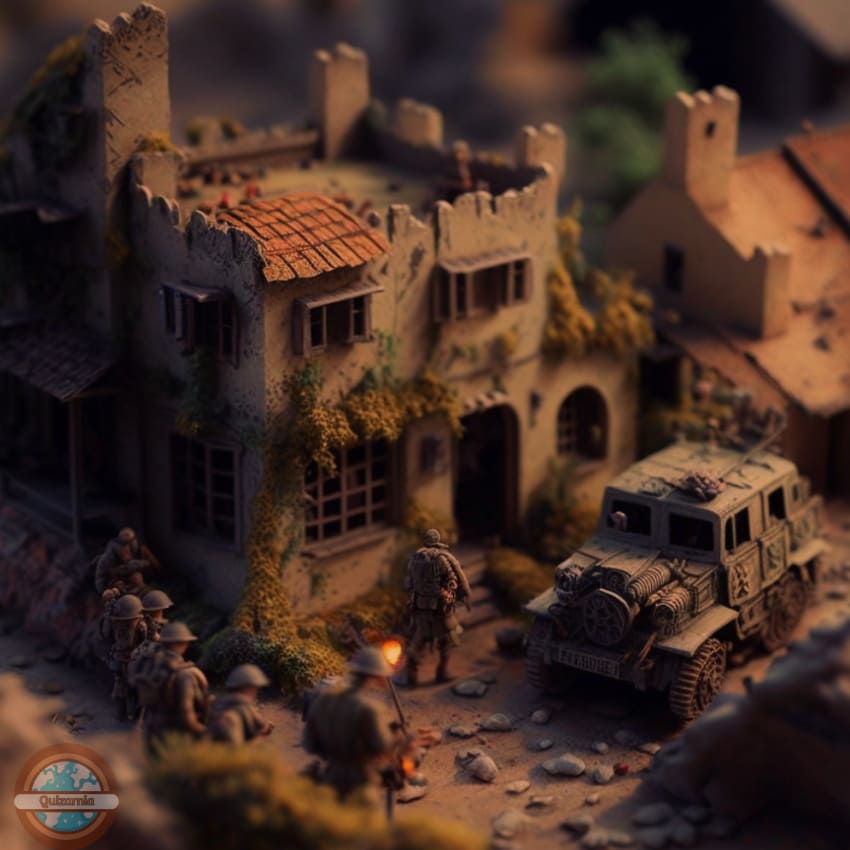
Step into the era that reshaped the modern world. The World War II Trivia challenges your memory, curiosity, and historical insight with 90 thought-provoking questions that range from the early battles to the aftermath of global reconstruction.
Whether you’re a passionate history buff or simply intrigued by the world’s most impactful conflict, this quiz will put your knowledge to the test, from easy to hard levels that progressively challenge even the most seasoned experts. Play now and prove your mastery of World War II! 🕹️
Get ready to explore every major aspect of the war through carefully designed questions divided into three difficulty levels (Easy, Medium, and Hard). Each level contains 10-question blocks, allowing you to test yourself step by step as you advance through the stages.
You’ll find questions covering:
The rise and fall of world leaders like Churchill, Roosevelt, and Hitler
Iconic battles including Stalingrad, Midway, and the Battle of the Bulge
Groundbreaking technology, intelligence missions, and war strategies
The human side of war, from soldiers and spies to resistance heroes
It’s more than just a WWII quiz, it’s an interactive journey through one of humanity’s most pivotal chapters.
Why This WWII Trivia Is Worth Playing
What makes this online World War II quiz stand out is its balance between education and engagement. It’s not about memorizing dates, it’s about understanding the connections, courage, and consequences that defined a generation.
Here’s why players love it:
Three levels of challenge – start with easy questions and climb your way to the expert tier.
Instant feedback – you can check your answers by clicking the reveal button at the end of each trivia set.
Engaging and free – learn, test, and improve your knowledge without paying a dime.
Perfect for all audiences – students, history enthusiasts, or anyone who loves a good brain workout.
Below you’ll find the World War II Trivia Questions and Answers section, where you can start your test. Remember, each trivia block contains 10 questions, and the difficulty ramps up as you go. Think you know your history? Let’s find out.
Easy World War II Trivia Questions
1. When did World War II begin?
World War II commenced on September 1, 1939, when Hitler initiated the invasion of Poland from the west. In response, two days later, France and Britain declared war on Germany, marking the beginning of the conflict.
2. Who were the Axis Powers during World War II?
The Axis alliance, comprising Germany, Italy, and Japan, had its three principal leaders in German dictator Adolf Hitler, Italian dictator Benito Mussolini, and Japanese Emperor Hirohito. These nations, under the leadership of this trio, formed a significant coalition during the course of World War II.
3. Who were the Allied Powers during World War II?
During World War II, the triumvirate of major Allied nations—comprising Great Britain, the United States, and the Soviet Union—established a Grand Alliance pivotal to achieving victory.
4. Which country invaded Poland, leading to the start of World War II?
On September 1, 1939, the invasion of Poland by German forces marked the catalyst for the onset of World War II. In reaction to the German aggression, Great Britain and France officially declared war on Nazi Germany.
5. Who was the leader of Germany during World War II?
In 1933, Adolf Hitler assumed the position of Chancellor in Germany after a succession of electoral triumphs for the Nazi Party. He wielded absolute control until his demise through suicide in April 1945.
6. Who was the leader of the United States during World War II?
Churchill and U.S. President Franklin Delano Roosevelt had collaborated for a considerable period when the United States joined the war in 1941. Roosevelt held the belief that a British triumph over the Axis powers aligned with America's best interests, whereas Churchill maintained that such a victory was unattainable without the support and assistance of the United States.
7. Who was the leader of the Soviet Union during World War II?
From 1929 to 1953, Joseph Stalin held the position of dictator in the Union of Soviet Socialist Republics (USSR).
8. What was the largest invasion in history during World War II?
The largest invasion in history during World War II was Operation Barbarossa, the German invasion of the Soviet Union launched in June 1941. It involved over 3.8 million Axis troops attacking along an 1,800-mile front, and was the largest land offensive in history.
9. Which two cities were hit by atomic bombs in Japan in 1945?
The United States deployed two atomic bombs over the Japanese cities of Hiroshima and Nagasaki on August 6 and 9, 1945, respectively.
10. What was the Holocaust?
The Holocaust encompassed the systematic extermination of Europe's Jewish population by the Nazis and their collaborators throughout the duration of the Second World War, from 1941 to 1945.
1. Who were the Nazis and what was their ideology?
Nazism, also known as National Socialism, denotes a totalitarian movement helmed by Adolf Hitler within Germany's Nazi Party from 1920 to 1945.
2. What was D-Day?
On June 6, 1944, the D-Day operation orchestrated the convergence of land, air, and sea forces from the allied armies, constituting the largest amphibious invasion in military history. Codenamed OVERLORD, the operation successfully landed five naval assault divisions on the beaches of Normandy, France.
3. Who were the Tuskegee Airmen?
The Tuskegee Airmen, pioneering as the initial African American military aviators in the United States armed forces, operated from 1940 to 1946. Over this period, Tuskegee Army Air Field trained a total of 996 pilots, with around 445 serving in overseas deployments. Sadly, 150 of these aviators lost their lives during this timeframe.
4. What was the Battle of Stalingrad?
Stalingrad emerged as a pivotal encounter on the Eastern Front during the Second World War. In this strategically significant city on the Volga River, named after the Soviet dictator Josef Stalin, the Soviet Union handed the German Army a catastrophic defeat.
5. Who were the Nisei soldiers?
During World War II, the Nisei, or second-generation Japanese Americans, actively sought the right to enlist in the armed forces. Despite encountering severe discrimination, they were determined to serve their country.
6. Who was Anne Frank?
Anne Frank, a German girl and a Jewish victim of the Holocaust, gained renown for meticulously chronicling her experiences in a diary. To escape Nazi persecution, Anne and her family concealed themselves for two years. Her poignant account of this period has been published as "The Diary of a Young Girl."
7. What was the Battle of Midway?
During June 1942, the United States and Japanese naval forces clashed in a decisive five-day battle in the central Pacific Ocean, altering the trajectory of the war in the Pacific. A significant moment captured in this event is depicted in the top image, showcasing the final moments on the damaged USS Yorktown (CV-5) near the Midway Islands.
8. Who were the Kamikaze pilots?
Japanese kamikaze attacks constituted a wartime strategy involving suicide bombings, specifically designed to annihilate enemy warships during World War II. Pilots would deliberately crash their specially crafted planes into Allied ships. The inaugural use of kamikaze bombers by the Empire of Japan took place on October 25, 1944.
9. What was the Battle of the Bulge?
The Battle of the Bulge, alternatively recognized as the Ardennes Offensive, marked a significant German offensive campaign on the Western Front in World War II, unfolding from December 16, 1944, to January 25, 1945. This offensive was initiated through the densely forested Ardennes region situated between Belgium and Luxembourg.
10. Who was Rosie the Riveter?
Today's working women can draw valuable lessons from the legendary war hero, Rosie the Riveter, who became a cultural icon representing women's strength and contribution to the industrial workforce during World War II. Transforming from a former housewife into a war hero, Rosie transcended traditional roles by leaving the kitchen to contribute significantly, constructing the machinery essential for the victory in World War II.
1. What was the Manhattan Project?
The Manhattan Project represented an unparalleled and classified government initiative during World War II. The United States, driven by a sense of urgency, undertook this endeavor with the aim of expeditiously creating and deploying the world's inaugural atomic weapons, preempting any potential development by Nazi Germany.
2. Who was Erwin Rommel?
Erwin Rommel (1891-1944), a distinguished German army officer, ascended to the esteemed rank of field marshal and gained renown both domestically and internationally for his command of Germany's Afrika Korps in North Africa during World War II. Dubbed "the Desert Fox," Rommel also assumed a pivotal role in directing German defenses against the Allied invasion of northern France.
3. What was the Battle of Iwo Jima?
Initiated on February 19, 1945, following extensive naval and air bombardment, the Battle of Iwo Jima saw the U.S. Marines launching an invasion. The Japanese defenders, strategically positioned within bunkers nestled deep within the volcanic rocks of the island, presented a formidable challenge. The engagement involved the participation of around 70,000 U.S. Marines and 18,000 Japanese soldiers.
4. Who was Dwight D. Eisenhower?
Dwight David Eisenhower (born David Dwight Eisenhower; October 14, 1890 – March 28, 1969), commonly known as Ike, was an American military officer and statesman. He held the distinguished position of the 34th president of the United States, serving from 1953 to 1961.
5. What was the Battle of Okinawa?
Taking place on April 1, 1945, Easter Sunday, the Battle of Okinawa emerged as the final major confrontation of World War II and proved to be one of the most fiercely contested. The Navy's Fifth Fleet, accompanied by over 180,000 U.S. Army and Marine Corps troops, initiated a decisive assault on the Pacific island of Okinawa, marking a critical stage in the concluding push towards Japan.
6. Who was Joseph Stalin?
Exercising authority as the General Secretary of the Communist Party of the Soviet Union from 1922 to 1952 and as the Chairman of the Council of Ministers of the Soviet Union from 1941 to 1953, he commenced his leadership as part of a collective governance structure. However, over the course of the 1930s, he gradually centralized power and evolved into a dictator, solidifying his control over the Soviet Union.
7. What was the Enigma machine?
Encoded messages were generated by the Enigma machine, wherein electrical signals originating from a keyboard resembling a typewriter passed through a sequence of rotating wheels and a plugboard. This process scrambled the output, yet in a manner that remained decipherable with the correct settings.
8. Who was Winston Churchill?
Winston Churchill, a figure of inspiration and multifaceted talents, distinguished himself as a statesman, writer, orator, and leader. His remarkable leadership played a pivotal role in guiding Britain to triumph during the Second World War. Churchill served as the Conservative Prime Minister on two occasions: firstly, from 1940 to 1945, leading the nation through war, and secondly, from 1951 to 1955. His tenure was briefly interrupted when he was defeated in the 1945 general election by the Labour leader Clement Attlee.
9. What was the Battle of Kursk?
Taking place on the vast steppe of Kursk oblast between July 5 and August 23, 1943, the Battle of Kursk stands out as a significant confrontation during the Second World War. This battle notably featured the largest tank engagement of the war.
10. Who was Douglas MacArthur?
General of the Army Douglas MacArthur, depicted in a 1945 photograph from the Library of Congress, dedicated the majority of his life to a distinguished career as an Army officer. One of the rare individuals to attain a five-star rank, MacArthur played significant roles in World War I, World War II, and the Korean War.
Intermediate World War II Trivia Questions
1. What were the key events that led to the United States entering World War II?
The Japanese assault on Pearl Harbor on December 7, 1941, conclusively resolved the debate over American intervention in both the Pacific and European theaters of World War II. In the immediate aftermath of the attack, Congress swiftly declared war on Imperial Japan, with only a solitary dissenting vote.
2. How did the war in Europe impact the war in the Pacific, and vice versa?
The conflict in Europe exerted a notable influence on the Pacific war, as Germany's military triumphs created upheaval in the Asian colonies of other European nations. Capitalizing on this situation, Japan sought to establish itself as the predominant imperial power in Asia, leading to a deterioration in relations between the United States and Japan.
3. What was the role of women during World War II in combat?
Women's auxiliary branches were established for each military division, such as the Women's Army Corps (WAC), Women Accepted for Volunteer Emergency Service (WAVES), and Women Airforce Service Pilots (WASP). While women were prohibited from combat zones, a significant number served as nurses, providing essential medical assistance to the men injured in combat.
4. What was the Battle of the Atlantic?
The Battle of the Atlantic epitomized the conflict between Allied and German forces for dominance in the Atlantic Ocean. The Allies aimed to sustain the crucial flow of men and supplies between North America and Europe, ensuring these resources could be utilized in the ongoing fighting. Conversely, the Germans sought to sever these supply lines, disrupting the Allied logistical network.
5. What was the Lend-Lease Act?
Enacted on March 11, 1941, this legislation established a framework enabling the United States to lend or lease war supplies to any nation considered "vital to the defense of the United States."
6. Why is the Battle of El Alamein significant?
The Battle of El Alamein marked the initial, unequivocal triumph secured by the British Army over the Axis forces. Following years of enduring setbacks, this victory provided a significant boost to British morale.
7. What was the role of propaganda during World War II?
In World War II, propaganda served the objectives of shaping morale, indoctrinating soldiers and military personnel, and influencing civilians in enemy countries.
8. What were the consequences of the Siege of Leningrad?
Persisting for 900 days from September 1941 to January 1944, the siege of Leningrad resulted in the tragic loss of 800,000 lives among the city's inhabitants, primarily due to cold and hunger. Additionally, the population endured enemy fire and stringent control imposed by the Soviet authorities.
9. What was the significance of the Battle of Guadalcanal in the Pacific Theater?
The Guadalcanal Campaign effectively halted Japanese expansion efforts and established the Allies in a position of undeniable supremacy. It can be asserted that this pivotal Allied triumph constituted the initial stride in a series of successes that ultimately culminated in the surrender of Japan and the occupation of the Japanese home islands.
10. How did the Battle of Monte Cassino impact the war effort in Italy?
The significance of the Battle of Monte Cassino lay in the potential for Allied troops to advance towards Rome upon the successful capture of the hill. Moreover, it played a crucial role in diverting German forces away from the Eastern Front, serving as a distraction during the finalization of D-Day plans.
1. What was the significance of the Battle of Kursk on the Eastern Front?
The Battle of Kursk stands as the most extensive tank confrontation in history, featuring around 6,000 tanks, 2,000,000 military personnel, and 4,000 aircraft. This pivotal engagement signaled the conclusive termination of Germany's offensive strength on the Eastern Front, paving the path for the significant Soviet offensives of 1944–45.
2. What was the role of espionage during World War II?
The progression of World War II was significantly influenced by espionage, with intelligence playing a vital role for key participants such as Britain, Germany, the Soviet Union, and the USA. Spies operated extensively across Europe, North Africa, and even South East Asia, as these major powers strategically integrated intelligence into their military operations.
3. What was the role of aircraft carriers during World War II?
In preparation for war, naval commanders steadfastly adhered to the notion that the outcome of naval battles hinged on the supremacy of large-caliber guns mounted on massive ships. The role assigned to aircraft carriers was to function as support vessels for the main battle line, offering aerial protection to complement the firepower of those substantial naval cannons.
4. What was the significance of the Battle of the Coral Sea in the Pacific Theater?
While the Battle of Coral Sea is frequently eclipsed by the subsequent events at Midway a month later, it holds its own significance. This engagement stands out as a crucial event, being the world's inaugural carrier-versus-carrier battle and the first naval conflict where the opposing fleets did not physically spot each other.
5. What was the role of submarines during World War II?
Submarines undertook a multifaceted role in addition to assaulting enemy vessels, including the rescue of downed pilots and engaging in various humanitarian efforts. The American submarine fleet, in particular, left a profound impact on the Imperial Japanese Navy and merchant ships by disrupting supply lines and severely impacting their expansive naval fleet.
6. What was the significance of the Battle of the Bulge on the Western Front?
The Battle of the Bulge served as the final German offensive on the Western Front, and the substantial losses incurred by Germany hindered their ability to impede the progress of Allied forces after the Normandy Invasion. In less than four months after the conclusion of the Battle of the Bulge, Germany capitulated to the advancing Allied forces.
7. How did the war impact the development of nuclear weapons?
In response to concerns during World War II about the possibility of their adversaries achieving nuclear weapons superiority, the United States and its allies initiated the Manhattan Project in 1942. This covert research endeavor, spearheaded by the U.S. government, aimed to develop nuclear weapons.
8. What was the role of partisan resistance groups during World War II?
World War II Soviet partisans, particularly those operating in Belarus, skillfully disrupted German military activities, causing substantial impediments to their operations in the region. This persistent resistance led to the re-establishment of Soviet authority deep within territories held by the Germans.
9. What was the significance of the Battle of the Philippine Sea in the Pacific Theater?
The significant naval confrontation known as the Battle of the Philippine Sea unfolded on 19–20 June 1944 during World War II. This pivotal engagement played a crucial role in neutralizing the Imperial Japanese Navy's capacity for extensive carrier operations. Notably, it occurred concurrently with the United States' amphibious invasion of the Mariana Islands as part of the broader Pacific War.
10. How did the war impact the global balance of power?
As of 1945, the era of European-led global dominance and competition came to a close, witnessing the demise of the traditional European balance of power doctrine. In its stead, a global balance of power emerged, with the United States and the Soviet Union ascending as the new superpowers, shaping a modern geopolitical landscape.
1. What was the role of the Yalta Conference in shaping the post-war world?
The post-World War II landscape was significantly influenced by the Yalta Conference. This historic gathering resulted in the division of Germany into four zones of control and similarly partitioned the city of Berlin into four zones. Additionally, the conference outlined plans for the Soviet Union to provide assistance on the eastern front following the defeat of the National Socialists, shaping the geopolitical dynamics of the time.
2. How did the war impact the social and cultural landscape of Asia?
In this era, the GDP of most Southeast Asian countries plummeted by half, leading to the premature deaths of 4.4 million civilians. Widespread shortages of food and essential goods afflicted nearly all inhabitants of Southeast Asia, while many lived in constant fear of harsh military rule.
3. What was the significance of the Battle of Berlin on the Eastern Front?
In the months of April and May 1945, the Battle of Berlin unfolded as a fierce conflict between German and Soviet forces. This pivotal engagement culminated in the demise of Adolf Hitler and the total collapse of the Nazi regime. Notably, the battle involved the participation of conscripted German civilians, frequently comprised of teenagers or elderly men, who were mobilized as part of a militia force known as the Volkssturm.
4. What was the role of the Red Army in the Eastern Front?
In its campaigns on the Eastern Front, the Red Army sustained a substantial 75–80% of the total casualties suffered by the Wehrmacht and Waffen-SS throughout World War II. Eventually, the Red Army achieved the capture of the German capital, Berlin. The Red Army boasted a massive force, with up to 34 million soldiers serving during World War II, including 8 million from non-Slavic minority groups.
5. What was the role of the United Nations in the aftermath of World War II?
Following World War II, the establishment of the United Nations aimed to foster international peace and security while promoting collaboration among nations to address economic, social, and humanitarian challenges. The League of Nations, conceived in comparable circumstances after World War I, served as its predecessor.
6. What was the significance of the Battle of Leyte Gulf in the Pacific Theater?
In 1944, the collective engagements at Leyte Gulf not only rendered the Imperial Japanese Navy ineffective as an offensive force but also played a pivotal role in decisively bringing about Japan's defeat in 1945.
7. What was the impact of the war on the economy of the United States?
During World War II, financing was facilitated through a combination of debt and increased taxes. By the war's conclusion, the U.S. gross debt had surpassed 120% of GDP, and tax revenue had surged to over 20% of GDP, more than three times the pre-war levels. Despite a remarkable GDP growth of over 17% in 1942, both consumption and investment underwent a significant contraction.
8. What was the role of the Italian Resistance during World War II?
Throughout the war, the movement exhibited immense power, liberating numerous cities in northern and central Italy prior to the Allies' arrival. This compelled the deployment of numerous German divisions across the country to counteract the guerrilla attacks initiated by the movement.
9. What was the significance of the Battle of Midway in the Pacific Theater?
This pivotal U.S. victory halted the expansion of Japan in the Pacific and strategically positioned the United States to initiate a systematic reduction of the Japanese empire. This was achieved through a sustained campaign of island-hopping invasions over the course of several years, coupled with significant naval battles that further contributed to the weakening and eventual shrinking of Japan's territorial holdings.
10. What was the impact of the war on the development of human rights?
Some of the most severe human rights violations occur in times of war. These transgressions encompass the use of rape as a weapon of war, the enlistment of children for frontline service, direct assaults on civilians and their infrastructure, and the execution of indiscriminate or disproportionate attacks.
Hard World War II Trivia Questions
1. How did the Battle of Peleliu impact the outcome of the war in the Pacific?
The triumph on Peleliu played a crucial role in preventing the Japanese from establishing a staging area for potential attacks on the U.S. fleet in the South Pacific. Additionally, it thwarted their ability to communicate effectively with their forces in the Philippines. Despite these strategic gains, the acquisition of the island came at a steep cost, underscoring the sacrifices made during the challenging and resource-intensive campaign.
2. What was the role of the Z Plan in shaping the naval strategy of the German Navy during World War II?
The plan outlined the formation of a fleet comprising ten battleships and four aircraft carriers, strategically positioned to engage the Royal Navy. In addition to this formidable naval presence, the fleet would be reinforced with numerous long-range cruisers tasked with targeting British shipping. A comparatively modest complement of U-boats was also specified in the plan.
3. Who was Franz Stangl?
Franz Paul Stangl, an Austrian police officer, assumed the role of commandant at the Nazi extermination camps Sobibor and Treblinka during World War II.
4. What was the significance of Operation Tidal Wave during the Allied bombing campaign in Europe?
The TIDALWAVE operation specifically aimed at nine significant refineries responsible for producing approximately 8,595,000 tons of oil annually, constituting around 90 percent of all Romanian oil production. The successful attack temporarily incapacitated about 3,925,000 tons, accounting for roughly 46 percent of the total annual production at Ploesti.
5. What was the role of the Soviet Union in the defeat of Japan during World War II?
Under the guise of neutrality, the Soviet Union clandestinely transported troops and equipment to the Far East, gearing up for the impending conflict against Japan. In July, the Japanese government approached Moscow, seeking mediation to conclude the war. Stalin seized the opportunity presented by the Japanese request to intentionally prolong the duration of the conflict.
6. Who was Wilhelm Canaris?
Wilhelm Canaris, born on January 1, 1887, in Aplerbeck, Westphalia, Germany, served as a German admiral and held the position of head of military intelligence (Abwehr) during the Nazi regime. Notably, he played a crucial role in the resistance of military officers against Adolf Hitler. Canaris met his tragic end on April 9, 1945, at the Flossenbürg concentration camp in Bavaria.
7. What was the consequence of the Battle of Bir Hakeim in the North African theater?
The staunch defense of Bir Hakeim significantly contributed to delaying the Axis offensive, influencing the ultimate cancellation of Operation Herkules, the planned Axis invasion of Malta. Rommel's invasion of Egypt faced impediments from British delaying actions, leading to a slowdown. The turning point came at the First Battle of El Alamein in July, where the Axis advance was effectively halted.
8. What was the significance of the Battle of Cape Esperance in the Pacific theater?
While the strategic outcome of the Battle of Cape Esperance remained inconclusive, it served as a crucial morale boost for the Navy. This was particularly significant in the aftermath of the calamitous defeat suffered off Savo Island, providing a positive turn of events that uplifted the spirits of the naval forces involved.
9. Who was General Bernard Montgomery?
Field Marshal Bernard Law Montgomery, 1st Viscount Montgomery of El-Alamein, commonly known as "Monty" or the "Spartan General," was a distinguished British military officer. He played a prominent and influential role during World War II, earning the rank of field marshal for his notable contributions to various campaigns.
10. What was the role of the Chindits in the Burma Campaign?
The Chindits were tasked with the mission of penetrating Burma through gaps in Japan's defenses, venturing deep into the country and operating behind Japanese lines. Their primary objective was to disrupt Japanese communications and launch attacks on the enemy's crucial supply lines.
1. What was the role of Reinhard Heydrich in the Holocaust and the Nazi regime?
Reinhard Heydrich played a pivotal role as one of the chief architects of the "Final Solution." Holding the position of Chief of the Reich Security Main Office, he was in charge of the SS and police agency primarily responsible for executing the Nazi plan to systematically murder the Jewish population of Europe during World War II.
2. How did the Battle of Leyte on the Pacific theater impact the outcome of the war?
The Battle of Leyte Gulf, occurring from October 23 to 26, 1944, stands as a pivotal air and sea confrontation during World War II. This decisive engagement significantly crippled the Japanese Combined Fleet, opening the way for the successful U.S. invasion of the Philippines. Moreover, it played a crucial role in reinforcing the Allies' control of the Pacific theater.
3. What was the role of the SOE in the resistance movements of occupied Europe during World War II?
Established in June 1940, the Special Operations Executive (SOE) emerged as a volunteer force dedicated to conducting a clandestine war. Operating behind enemy lines, its agents were primarily engaged in acts of sabotage and subversion. Prime Minister Winston Churchill, a fervent advocate, famously urged them to "set Europe ablaze," underscoring the importance of their covert activities.
4. What was the impact of Admiral Isoroku Yamamoto on the strategy of the Japanese Navy during the war?
Admiral Isoroku Yamamoto, who masterminded the attack on Pearl Harbor, played a decisive role in shaping Japan’s naval aviation strategy during the war. While he is often associated with aircraft carriers, his influence extended notably to the development of land-based naval aviation, especially with the Mitsubishi G3M and G4M medium bombers. Yamamoto's efforts played a crucial role in shaping the capabilities of Japanese air forces during his tenure.
5. What was the significance of the Battle of Gazala in the North African theater?
The Battle of Gazala stands as the pinnacle of Rommel's career, marked as his greatest victory. As both the Allied and Axis forces approached exhaustion, the Eighth Army successfully halted the Axis advance at the First Battle of El Alamein. In a strategic shift, the planned attack on Malta (Operation Herkules) was postponed to lend support to the Axis advance into Egypt.
6. What was the role of the Office of Strategic Services (OSS) in the intelligence operations of the Allied Powers during World War II?
The Office of Strategic Services (OSS) was a U.S. federal government agency that operated from 1942 to 1945 with the primary objective of gathering intelligence and conducting sabotage against the military efforts of enemy nations during World War II.
7. What was the impact of Fritz Todt on the construction of military infrastructure during the war?
Fritz Todt was tasked with overseeing the construction of the "West Wall," commonly known as the "Siegfried Line" in English-speaking countries. This defensive fortification was erected to protect the territory of the Reich.
8. What was the significance of the Battle of Narvik in the Norwegian Campaign?
The Battle of Narvik was significant because it was the site of intense naval fighting and ground battles crucial for controlling Germany's vital supply of Swedish iron ore via its ice-free port. It was also the first place in World War II where Germany was driven out of a city by Allied forces, which was a major symbolic victory for the Allies despite their eventual withdrawal and German occupation of Norway.
9. Who was General Heinz Guderian?
Heinz Wilhelm Guderian (17 June 1888 – 14 May 1954) was a German general in World War II and later gained success as a memoirist. Recognized as an early pioneer and proponent of the "blitzkrieg" approach, he played a pivotal role in shaping the panzer division concept during the war.
10. What was the role of the Waffen-SS in the war effort of the Nazi regime?
The Waffen-SS served as the military branch of the SS (Schutzstaffel) in Nazi Germany. Throughout World War II, it actively participated in numerous military campaigns conducted by Nazi forces.
1. What was the impact of Hideki Tojo on the political strategy of Japan during the war?
Tojo was a staunch advocate of the Tripartite Pact, forging a close alliance between Imperial Japan, Nazi Germany, and Fascist Italy. As the army minister, he furthered the expansion of the war against China. Following negotiations with Vichy France, Japan obtained permission to deploy its troops in the southern part of French Indochina in July 1941.
2. What was the significance of the Battle of the Java Sea in the Pacific theater?
The Battle of the Java Sea marked the conclusion of significant Allied naval operations in Southeast Asia in 1942. Following this naval engagement, Japanese land forces invaded Java on 28 February. The Dutch surface fleet suffered near-complete destruction in Asian waters, and as a consequence, the Netherlands never regained full control of its colony.
3. Who was Albert Speer, and what was his impact on the war effort of the Nazi regime?
In his role as Minister of Armaments, Albert Speer was tasked with the responsibility of supplying weapons to the German army during World War II. With Hitler's full approval, Speer made the decision to prioritize tank production, and he wielded unprecedented authority to guarantee the success of this strategic focus.
4. What was the role of the 1st Canadian Parachute Battalion in the war effort of the Allied Powers?
The battalion was assigned several tasks, including the destruction of the radio station at Varaville, securing the Drop Zone (DZ), providing protection for the flanks of the 9th Parachute Battalion's operations at Merville, and demolishing bridges at Varaville and Dives.
5. What was the Battle of Bir Hakeim?
From 26 May to 11 June 1942, the 1st Free French Brigade (1st BFL) confronted the Afrika Korps and its Italian allies on the Libyan front. The brigade steadfastly held its position at Bir Hakeim and only withdrew once it had ensured the safe retreat of British troops.
6. What was the importance of William J. Donovan on the intelligence operations of the Allied Powers during the war?
William J. Donovan organized the Office of Strategic Services (OSS) to embody his vision of a national intelligence center. The OSS, established during World War II, uniquely integrated research and analysis, covert operations, counterintelligence, espionage, and technical development—a combination that laid the groundwork for the core missions of the modern Central Intelligence Agency (CIA).
7. What was the role of the Special Air Service (SAS) in the resistance movements of occupied Europe during World War II?
Established during the Second World War, the Special Air Service (SAS) conducted operations behind enemy lines in North Africa and Europe. Today, this elite unit is widely recognized for its highly trained personnel who excel in covert surveillance, close-combat fighting, and hostage rescue missions.
8. Who was Admiral Karl Dönitz, and what was his impact on the strategy of the German Navy during the war?
Karl Dönitz emerged as the primary adversary for Allied naval forces during the Battle of the Atlantic. While German U-boats proved highly effective from 1939 to 1943, they eventually lost the initiative by May 1943. Despite this shift, Dönitz continued to order his submarines into battle until 1945 to alleviate pressure on other branches of the Wehrmacht (armed forces).
9. What was the significance of the Battle of Kohima in the Burma Campaign?
Fought from 8 March to 18 July 1944, these battles marked a turning point in one of the most challenging campaigns of the Second World War (1939-45). The decisive Japanese defeat in northeast India served as the springboard for the subsequent re-conquest of Burma by the Fourteenth Army.
10. Who was Violette Szabo?
Violette Szabo was a courageous agent of the British/French Special Operations Executive (SOE) during World War II, recognized for her exceptional bravery with the award of the George Cross.
FAQs
What topics does this WWII quiz cover? It spans major battles, political leaders, military strategies, resistance movements, and post-war outcomes.
Is this World War II trivia free? Yes, it’s a completely free online quiz. No sign-up required, just dive in and play.
How are the questions organized? The quiz has 90 questions split evenly into easy, medium, and hard levels, allowing a gradual progression in difficulty.
Can I see the correct answers? Absolutely! Just click the button at the end of each trivia section to reveal the answers.
Final Call: Step Into History
Whether you’re testing your knowledge, learning something new, or competing with friends, the World War II Trivia offers a unique way to relive the key moments that shaped the 20th century.
Sharpen your memory, uncover forgotten facts, and see how deep your understanding of the Second World War truly goes.